
Introduction
In today's competitive manufacturing landscape, bringing high-quality products to market quickly is more important than ever. Companies are expected to innovate faster, reduce development costs, and collaborate efficiently across multiple teams. This is where Product Lifecycle Management (PLM) plays a vital role.
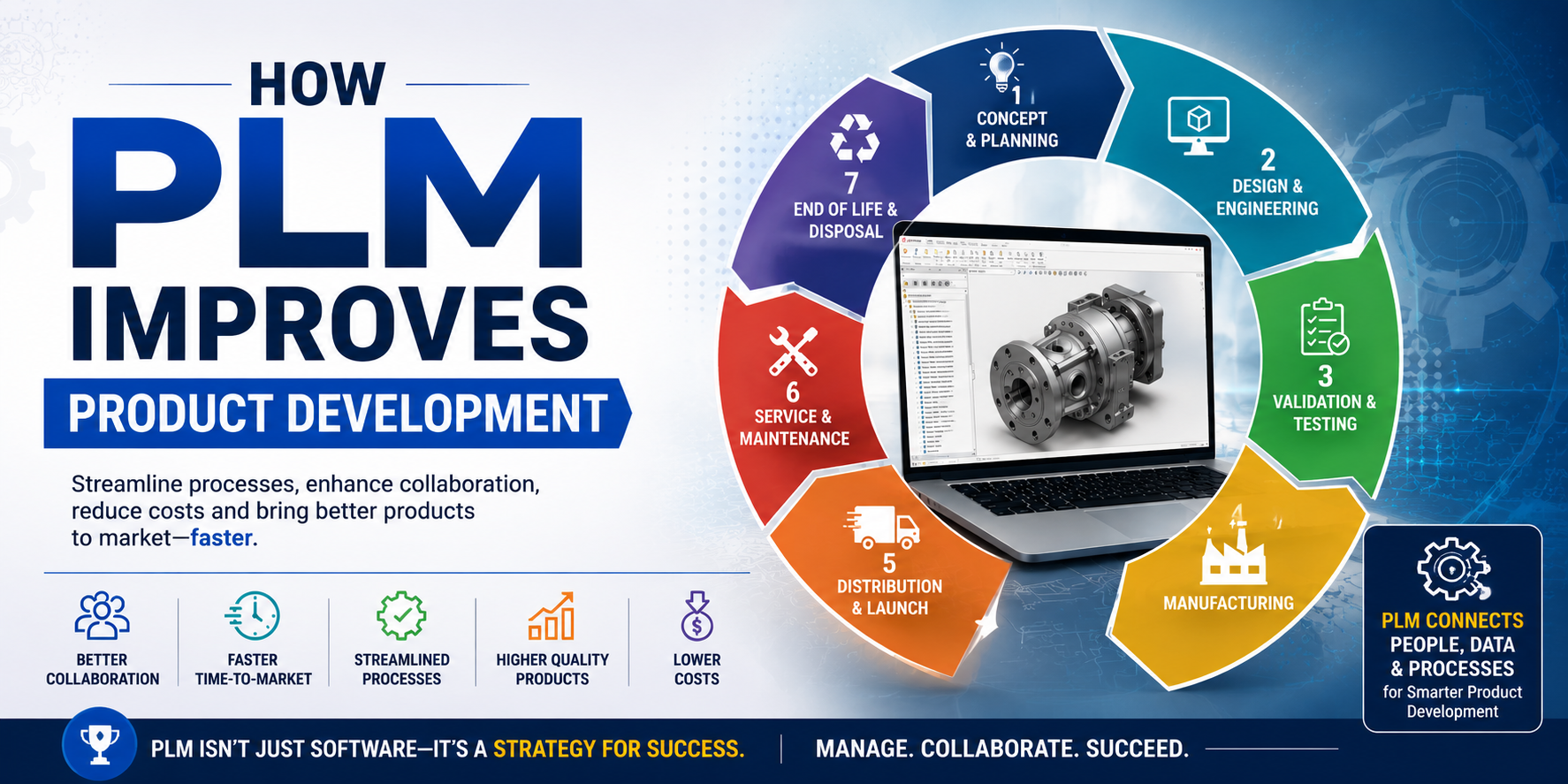
PLM is more than just software—it's a strategy for managing product information, processes, and collaboration throughout the entire product lifecycle. From the first design concept to manufacturing, maintenance, and product retirement, PLM ensures that every stakeholder has access to accurate and up-to-date information.
This article explains how PLM improves product development and why it has become an essential tool for modern engineering organizations.
What Is Product Lifecycle Management (PLM)?
Product Lifecycle Management (PLM) is a system that manages all product-related data, documents, workflows, and processes throughout the product's lifecycle.
The typical stages of a product lifecycle include:
- Concept & Idea Generation
- Product Design
- Engineering Validation
- Manufacturing
- Product Launch
- Maintenance & Service
- End-of-Life Management
Instead of storing files across multiple folders and departments, PLM creates a centralized repository where everyone works with the latest product information.
Challenges Without PLM
Many organizations still rely on spreadsheets, shared folders, emails, and manual processes to manage product data. This often leads to:
- Multiple versions of CAD files
- Poor communication between departments
- Delayed engineering changes
- Duplicate design work
- Manufacturing errors
- Lost documentation
- Longer product development cycles
- Higher development costs
As products become more complex, these challenges become increasingly difficult to manage.
How PLM Improves Product Development
1. Centralized Product Data Management
One of the biggest advantages of PLM is that all product information is stored in a single location. This includes:
- CAD models
- Drawings
- Bills of Materials (BOM)
- Specifications
- Test reports
- Manufacturing documents
- Supplier information
Benefits: Reduced duplicate work, faster information access, better collaboration, and improved data accuracy.
2. Faster Design Collaboration
Modern product development involves multiple teams working together, including mechanical, electrical, and manufacturing engineers, alongside quality, procurement, and supplier teams.
PLM allows all stakeholders to collaborate using the same product information. Features such as check-in/check-out, comments, notifications, and workflow approvals help teams work together without overwriting each other's changes.
3. Better Version Control
Managing different revisions of CAD files can be challenging. PLM automatically tracks design revisions, file history, author information, approval status, and release dates. This prevents accidental use of outdated files during manufacturing.
Instead of naming files like:
Gear_v3_Final_Final_NEW.SLDPRTPLM maintains an official revision history such as:
Rev A, Rev B, Rev C—making document management much cleaner and more reliable.4. Streamlined Engineering Change Management
Engineering changes are common during product development. Without PLM, change requests may be communicated through emails or spreadsheets, increasing the risk of mistakes.
PLM automates:
- Engineering Change Request (ECR)
- Engineering Change Order (ECO)
- Engineering Change Notice (ECN)
- Approval workflows & change tracking
This ensures every change is documented, reviewed, approved, and implemented correctly.
5. Improved Bill of Materials (BOM) Management
A Bill of Materials is the backbone of manufacturing. PLM helps maintain:
- Engineering BOM (EBOM)
- Manufacturing BOM (MBOM)
- Service BOM
Any design modification automatically updates related product structures, reducing manual work and minimizing errors.
6. Faster Time-to-Market
Reducing product development time provides a significant competitive advantage. PLM accelerates development by reducing approval delays, eliminating duplicate work, automating workflows, improving communication, and providing real-time product visibility. Teams spend less time searching for information and more time designing better products.
7. Better Cross-Department Collaboration
Product development doesn't involve engineering alone. Departments including manufacturing, purchasing, sales, service, quality assurance, and supply chain all need access to accurate product information. PLM connects these departments through shared workflows and centralized data.
8. Enhanced Product Quality
PLM improves product quality by ensuring standardized design processes, better documentation, controlled revisions, design validation, approval workflows, and full traceability. This reduces manufacturing defects and improves overall product reliability.
9. Improved Compliance and Traceability
Many industries require strict documentation and regulatory compliance. PLM maintains complete traceability for design changes, material selection, testing records, certifications, and product approvals, which simplifies audits significantly.
10. Cost Reduction
PLM reduces development costs by minimizing design rework, manufacturing errors, scrap, duplicate parts, delayed approvals, and manual documentation. Although implementing PLM requires an initial investment, organizations often achieve significant long-term savings through improved efficiency.
PLM Workflow Example
A simplified PLM workflow looks like this:
- Product idea is created.
- Engineers develop CAD models.
- Design files are stored in PLM.
- Design reviews are conducted.
- Changes are approved using ECR/ECO workflows.
- BOM is finalized.
- Manufacturing receives released data.
- Product is produced.
- Service teams access product documentation.
- Product revisions continue throughout its lifecycle.
Industries That Benefit from PLM
Any company developing complex products can benefit from a structured PLM system. Key industries include:
- Automotive
- Aerospace
- Industrial Machinery
- Consumer Electronics
- Medical Devices
- Heavy Equipment
- Industrial Automation
- Robotics
- Energy
- Defense
PLM and CAD Integration
Modern PLM systems integrate seamlessly with leading CAD software, including:
- SOLIDWORKS
- Autodesk Inventor
- PTC Creo
- Siemens NX
- CATIA
This integration allows engineers to save, manage, revise, and release CAD files directly within the PLM environment, reducing manual effort and improving data consistency.
Key Benefits of PLM at a Glance
- Centralized product data
- Better collaboration
- Controlled document revisions
- Faster engineering changes
- Efficient BOM management
- Reduced development time
- Improved product quality
- Lower manufacturing costs
- Regulatory compliance
- Enhanced traceability
- Better decision-making
- Faster product launches
Master SOLIDWORKS with Real-World Projects
Understanding PLM is just one part of successful product development. To effectively manage product data within a PLM environment, strong CAD modeling skills are essential.
The SOLIDWORKS Mastery Pack from CADArtifex builds industry-ready expertise through comprehensive training and practical, hands-on projects tailored for mechanical engineers, product designers, and students.
Conclusion
Product Lifecycle Management has become a cornerstone of modern product development. By centralizing product data, improving collaboration, automating engineering workflows, and maintaining complete traceability, PLM helps organizations design better products in less time while reducing costs and minimizing errors.
Whether you're a startup developing your first product or a large manufacturing company managing thousands of components, implementing a robust PLM strategy can significantly improve productivity and competitiveness. As products become more complex and development cycles continue to shrink, PLM is no longer just an advantage—it's a necessity for efficient, high-quality product development.

 - 1185-360x220.png)
 - 1452-360x220.png)
